Bayfront Park Seawall
Share Bayfront Park Seawall on Facebook Share Bayfront Park Seawall on X (formerly Twitter) Share Bayfront Park Seawall on Linkedin Email Bayfront Park Seawall link

Key Facts at a Glance

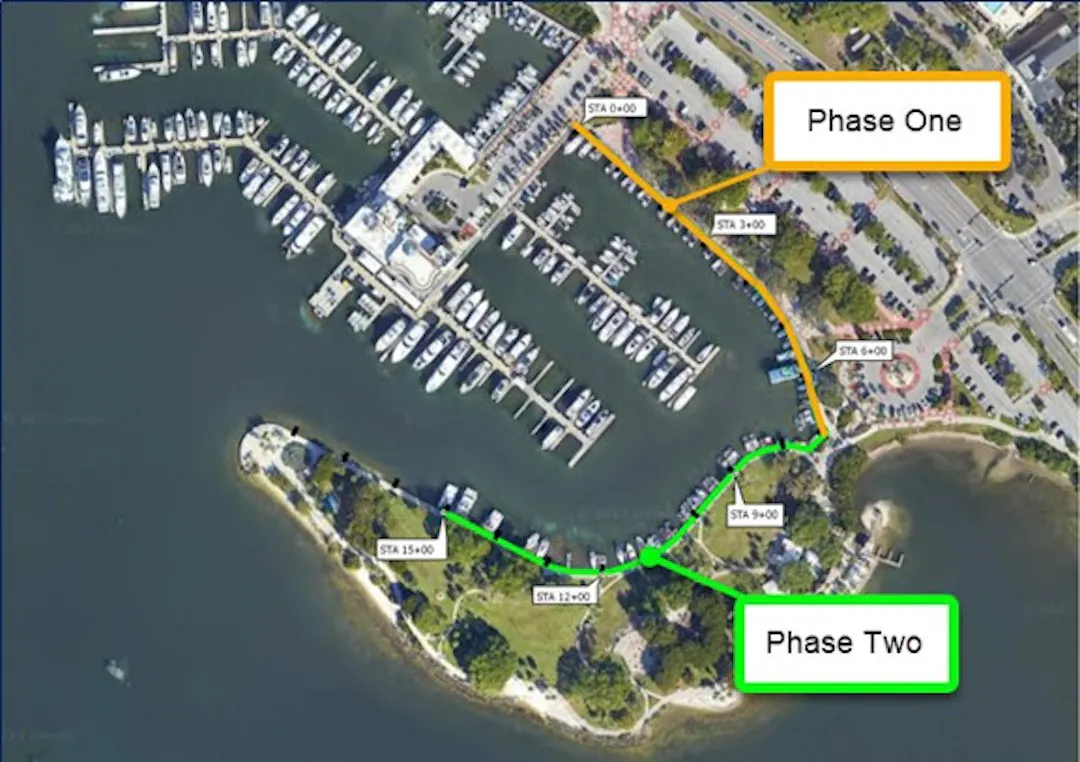
  • The project will replace approximately 1,506 linear feet of seawall along Bayfront Park and the A Dock area of the marina.
  • The seawall cap will be raised by approximately 1 foot 10 inches to improve resiliency and better protect public infrastructure, park assets, marina facilities, and public access areas.
  • The total project cost is $5,569,022.03.
  • Funding includes grants from the Florida Department of Environmental Protection and the West Coast Inland Navigation District, along with City Capital Improvement Program funds.
  • The construction contract was brought to the City Commission on May 18, 2026.
  • The contractor is Earth Tech Enterprises, Inc.
  • The project was reviewed through the City’s technical review process, including coordination through the Development Review Committee and review by appropriate City staff.
  • Based on a recent reassessment by the City Surveyor and City Arborist, the project team reviewed tree conditions, preservation options, construction impacts, and replacement plantings.
  • Across both phases, the project includes the planting of 85 new trees, plus 31 firebush plants and 59 sea grape plants.

Project Purpose

The City of Sarasota is moving forward with the Bayfront Park Seawall Reconstruction Project to replace aging seawall infrastructure along Bayfront Park and the A Dock area of the marina.

The project will strengthen the waterfront, improve long-term resiliency, and better protect public infrastructure and park assets from tidal, storm, and sea level rise conditions. Work includes raising the seawall cap, raising adjacent landward grades, improving drainage, and installing environmental panels that support water-filtering organisms.

Why the Project Is Needed

The existing seawall protects Bayfront Park, marina operations, public access areas, and nearby public infrastructure. Reconstruction is needed to:

  • Replace aging seawall infrastructure.
  • Increase resiliency by raising the seawall cap and adjacent grades.
  • Improve drainage and reduce long-term maintenance concerns.
  • Better protect park amenities, marina facilities, and public infrastructure.
  • Maintain safe public access in areas outside active construction zones.
  • Add environmental and landscape improvements to the bayfront.

Cost and Funding

The total project cost is $5,569,022.03.

Funding sources include:

  • Florida Department of Environmental Protection Grant: $3,588,000.00
  • West Coast Inland Navigation District Grant: $500,000.00
  • City Capital Improvement Program Funds: Remaining project balance

Project Timeline

  • Phase One Start Date: May 5, 2026
  • Phase One Substantial Completion: September 2026
  • Phase Two Start Date: Late 2026 / Early 2027
  • Project Completion: Spring/Summer 2027

Contractor

The contractor is Earth Tech Enterprises, Inc.

City Commission, City Manager, and Staff Roles

The City Commission’s role is to provide policy direction, approve project funding, authorize major contracts or agreements when required, and receive public input and project updates. The construction contract for this project was first brought to the City Commission on May 4, 2026.

The City Manager and City staff’s role is to administer and implement the approved project. This includes managing the contractor, coordinating construction activities, reviewing technical issues, evaluating tree preservation and replanting options, maintaining public access where feasible, coordinating marina operations, and communicating project information to the public.

Day-to-day project decisions related to construction sequencing, field conditions, technical design, tree assessments, contractor coordination, and implementation are handled administratively by City staff under the direction of the City Manager.

Development Review Committee and Technical Review

The project was reviewed through the City’s technical review process, including coordination with the Development Review Committee on August 6, 2025, and review by appropriate City disciplines, with sign-off on October 28, 2025.

This review process helps evaluate the project's impacts on construction, drainage, utilities, park access, marina operations, landscaping, tree preservation, public safety, and long-term maintenance. The recent tree reassessment on May 21, 2026, included review by the City Surveyor and City Arborist to confirm existing tree conditions, evaluate possible preservation options, and verify the proposed replanting plan.

Tree Preservation, Removal, and Replanting

The City recognizes the community’s concern regarding tree removals at Bayfront Park. The project team has reviewed tree conditions, construction impacts, preservation options, and required replacement plantings.

The City’s approach is to preserve trees where feasible, remove only those trees that conflict with the required seawall construction or have limited long-term viability, and restore the area with healthy vegetation appropriate for the waterfront environment.

Why Some Trees Must Be Removed

Tree removal is necessary in certain areas because of the structural system required to safely rebuild the seawall.

Due to poor soil conditions, the new seawall requires a dead-man tie-back system. This system creates a construction disturbance area of approximately 30 to 35 feet behind the existing seawall. Additional fill is also required to promote positive drainage toward the seawall.

Where trees conflict with the tie-back system, grading, drainage, retaining needs, or construction footprint, removal is necessary. In some cases, transplanting or preservation is not feasible because mature trees may not survive significant root disturbance, grade changes, or construction impacts.

Phase One Tree Impacts and Replanting

Trees to Be Removed

Phase One includes the removal of 11 live oak trees:

  • 9 live oaks are listed in poor condition.
  • 1 live oak is listed in fair condition.
  • 1 live oak is listed in good condition.

The live oak listed in good condition was reviewed for possible preservation. However, saving the tree would require specialized drainage improvements and costly retaining walls. Given the construction disturbance in this area, the tree would also have a low likelihood of long-term survival.

Trees to Be Installed in Phase One

Phase One includes 38 new trees.

Required by City Code: 12 trees

  • 7 live oak trees, 5-inch diameter at breast height
  • 5 gumbo limbo trees, 3-inch diameter at breast height

Additional trees above City Code requirements: 26 trees

  • 9 black olive trees, 3-inch diameter at breast height
  • 4 buttonwood trees, 3-inch diameter at breast height
  • 13 cabbage palms, 8- to 12-foot clear trunk

Phase Two Tree Impacts and Replanting

Trees Identified for Removal

Phase Two includes up to 21 trees identified for removal before final preservation efforts:

  • 3 royal palms in poor condition
  • 5 banyan trees
  • 1 Geiger tree
  • 1 live oak tree
  • 8 cabbage palms
  • 1 thatch palm
  • 2 coconut palms

Trees Reconsidered for Preservation

Following the recent reassessment, 2 banyan trees are planned to be saved through minor project modifications and based on site conditions.

If successful, this would reduce Phase Two removals from 21 trees to 19 trees and reduce banyan removals from 5 banyans to 3 banyans.

Trees to Be Installed in Phase Two

Phase Two includes 47 new trees.

Required by City Code: 27 trees

  • 7 live oak trees, 5-inch diameter at breast height
  • 8 live oak trees, 3-inch diameter at breast height
  • 12 gumbo limbo trees, 3-inch diameter at breast height

Additional trees above City Code requirements: 20 trees

  • 4 black olive trees, 3-inch diameter at breast height
  • 10 pitch apple trees, 3-inch diameter at breast height
  • 2 buttonwood trees, 3-inch diameter at breast height
  • 4 cabbage palms, 8- to 12-foot clear trunk

Total Landscaping Commitment

Across both phases, the project includes the planting of 85 new trees.

This includes:

  • 39 trees required by City Code
  • 46 additional trees above City Code requirements

The project also includes additional coastal landscaping:

  • 31 firebush plants
  • 59 sea grape plants

This means the project is not only meeting City Code replacement requirements but also adding a significant number of additional trees and plantings to improve the long-term landscape, shade, and coastal character of Bayfront Park.

Marina Operations

Marina operations will continue during construction. The contractor has agreed to provide boat slips incrementally as construction progresses.

Park Access

Park access will be maintained in areas outside active construction zones.

Limited access to Phase One areas will be restored as construction transitions into Phase Two. Full Park access is anticipated upon project completion in Spring/Summer 2027.

Project Enhancements

The project includes:

  • A higher seawall cap designed to support long-term resiliency.
  • Raised landward grades to improve drainage and protect public infrastructure.
  • Mangrove-style panels that mimic mangrove roots and promote water-filtering organisms.
  • Planting 85 new trees.
  • Additional coastal landscaping, including firebush and sea grapes.
  • Improved protection for Bayfront Park, marina facilities, public access areas, and waterfront infrastructure.

Key Message

The Bayfront Park Seawall Reconstruction Project is a necessary investment in Sarasota’s public waterfront. The project will replace aging seawall infrastructure, increase resiliency, protect public infrastructure, improve drainage, support marina operations, and enhance the bayfront landscape.

While some tree removals are required because of the seawall construction footprint, soil conditions, drainage needs, and structural tie-back system, the City has reassessed the removals with the City Surveyor and City Arborist, preserved trees where feasible, and committed to substantial replanting.

When complete, the project will provide stronger shoreline protection, environmental benefits, continued public access, and a healthier long-term landscape for Bayfront Park.


Key Facts at a Glance

  • The project will replace approximately 1,506 linear feet of seawall along Bayfront Park and the A Dock area of the marina.
  • The seawall cap will be raised by approximately 1 foot 10 inches to improve resiliency and better protect public infrastructure, park assets, marina facilities, and public access areas.
  • The total project cost is $5,569,022.03.
  • Funding includes grants from the Florida Department of Environmental Protection and the West Coast Inland Navigation District, along with City Capital Improvement Program funds.
  • The construction contract was brought to the City Commission on May 18, 2026.
  • The contractor is Earth Tech Enterprises, Inc.
  • The project was reviewed through the City’s technical review process, including coordination through the Development Review Committee and review by appropriate City staff.
  • Based on a recent reassessment by the City Surveyor and City Arborist, the project team reviewed tree conditions, preservation options, construction impacts, and replacement plantings.
  • Across both phases, the project includes the planting of 85 new trees, plus 31 firebush plants and 59 sea grape plants.

Project Purpose

The City of Sarasota is moving forward with the Bayfront Park Seawall Reconstruction Project to replace aging seawall infrastructure along Bayfront Park and the A Dock area of the marina.

The project will strengthen the waterfront, improve long-term resiliency, and better protect public infrastructure and park assets from tidal, storm, and sea level rise conditions. Work includes raising the seawall cap, raising adjacent landward grades, improving drainage, and installing environmental panels that support water-filtering organisms.

Why the Project Is Needed

The existing seawall protects Bayfront Park, marina operations, public access areas, and nearby public infrastructure. Reconstruction is needed to:

  • Replace aging seawall infrastructure.
  • Increase resiliency by raising the seawall cap and adjacent grades.
  • Improve drainage and reduce long-term maintenance concerns.
  • Better protect park amenities, marina facilities, and public infrastructure.
  • Maintain safe public access in areas outside active construction zones.
  • Add environmental and landscape improvements to the bayfront.

Cost and Funding

The total project cost is $5,569,022.03.

Funding sources include:

  • Florida Department of Environmental Protection Grant: $3,588,000.00
  • West Coast Inland Navigation District Grant: $500,000.00
  • City Capital Improvement Program Funds: Remaining project balance

Project Timeline

  • Phase One Start Date: May 5, 2026
  • Phase One Substantial Completion: September 2026
  • Phase Two Start Date: Late 2026 / Early 2027
  • Project Completion: Spring/Summer 2027

Contractor

The contractor is Earth Tech Enterprises, Inc.

City Commission, City Manager, and Staff Roles

The City Commission’s role is to provide policy direction, approve project funding, authorize major contracts or agreements when required, and receive public input and project updates. The construction contract for this project was first brought to the City Commission on May 4, 2026.

The City Manager and City staff’s role is to administer and implement the approved project. This includes managing the contractor, coordinating construction activities, reviewing technical issues, evaluating tree preservation and replanting options, maintaining public access where feasible, coordinating marina operations, and communicating project information to the public.

Day-to-day project decisions related to construction sequencing, field conditions, technical design, tree assessments, contractor coordination, and implementation are handled administratively by City staff under the direction of the City Manager.

Development Review Committee and Technical Review

The project was reviewed through the City’s technical review process, including coordination with the Development Review Committee on August 6, 2025, and review by appropriate City disciplines, with sign-off on October 28, 2025.

This review process helps evaluate the project's impacts on construction, drainage, utilities, park access, marina operations, landscaping, tree preservation, public safety, and long-term maintenance. The recent tree reassessment on May 21, 2026, included review by the City Surveyor and City Arborist to confirm existing tree conditions, evaluate possible preservation options, and verify the proposed replanting plan.

Tree Preservation, Removal, and Replanting

The City recognizes the community’s concern regarding tree removals at Bayfront Park. The project team has reviewed tree conditions, construction impacts, preservation options, and required replacement plantings.

The City’s approach is to preserve trees where feasible, remove only those trees that conflict with the required seawall construction or have limited long-term viability, and restore the area with healthy vegetation appropriate for the waterfront environment.

Why Some Trees Must Be Removed

Tree removal is necessary in certain areas because of the structural system required to safely rebuild the seawall.

Due to poor soil conditions, the new seawall requires a dead-man tie-back system. This system creates a construction disturbance area of approximately 30 to 35 feet behind the existing seawall. Additional fill is also required to promote positive drainage toward the seawall.

Where trees conflict with the tie-back system, grading, drainage, retaining needs, or construction footprint, removal is necessary. In some cases, transplanting or preservation is not feasible because mature trees may not survive significant root disturbance, grade changes, or construction impacts.

Phase One Tree Impacts and Replanting

Trees to Be Removed

Phase One includes the removal of 11 live oak trees:

  • 9 live oaks are listed in poor condition.
  • 1 live oak is listed in fair condition.
  • 1 live oak is listed in good condition.

The live oak listed in good condition was reviewed for possible preservation. However, saving the tree would require specialized drainage improvements and costly retaining walls. Given the construction disturbance in this area, the tree would also have a low likelihood of long-term survival.

Trees to Be Installed in Phase One

Phase One includes 38 new trees.

Required by City Code: 12 trees

  • 7 live oak trees, 5-inch diameter at breast height
  • 5 gumbo limbo trees, 3-inch diameter at breast height

Additional trees above City Code requirements: 26 trees

  • 9 black olive trees, 3-inch diameter at breast height
  • 4 buttonwood trees, 3-inch diameter at breast height
  • 13 cabbage palms, 8- to 12-foot clear trunk

Phase Two Tree Impacts and Replanting

Trees Identified for Removal

Phase Two includes up to 21 trees identified for removal before final preservation efforts:

  • 3 royal palms in poor condition
  • 5 banyan trees
  • 1 Geiger tree
  • 1 live oak tree
  • 8 cabbage palms
  • 1 thatch palm
  • 2 coconut palms

Trees Reconsidered for Preservation

Following the recent reassessment, 2 banyan trees are planned to be saved through minor project modifications and based on site conditions.

If successful, this would reduce Phase Two removals from 21 trees to 19 trees and reduce banyan removals from 5 banyans to 3 banyans.

Trees to Be Installed in Phase Two

Phase Two includes 47 new trees.

Required by City Code: 27 trees

  • 7 live oak trees, 5-inch diameter at breast height
  • 8 live oak trees, 3-inch diameter at breast height
  • 12 gumbo limbo trees, 3-inch diameter at breast height

Additional trees above City Code requirements: 20 trees

  • 4 black olive trees, 3-inch diameter at breast height
  • 10 pitch apple trees, 3-inch diameter at breast height
  • 2 buttonwood trees, 3-inch diameter at breast height
  • 4 cabbage palms, 8- to 12-foot clear trunk

Total Landscaping Commitment

Across both phases, the project includes the planting of 85 new trees.

This includes:

  • 39 trees required by City Code
  • 46 additional trees above City Code requirements

The project also includes additional coastal landscaping:

  • 31 firebush plants
  • 59 sea grape plants

This means the project is not only meeting City Code replacement requirements but also adding a significant number of additional trees and plantings to improve the long-term landscape, shade, and coastal character of Bayfront Park.

Marina Operations

Marina operations will continue during construction. The contractor has agreed to provide boat slips incrementally as construction progresses.

Park Access

Park access will be maintained in areas outside active construction zones.

Limited access to Phase One areas will be restored as construction transitions into Phase Two. Full Park access is anticipated upon project completion in Spring/Summer 2027.

Project Enhancements

The project includes:

  • A higher seawall cap designed to support long-term resiliency.
  • Raised landward grades to improve drainage and protect public infrastructure.
  • Mangrove-style panels that mimic mangrove roots and promote water-filtering organisms.
  • Planting 85 new trees.
  • Additional coastal landscaping, including firebush and sea grapes.
  • Improved protection for Bayfront Park, marina facilities, public access areas, and waterfront infrastructure.

Key Message

The Bayfront Park Seawall Reconstruction Project is a necessary investment in Sarasota’s public waterfront. The project will replace aging seawall infrastructure, increase resiliency, protect public infrastructure, improve drainage, support marina operations, and enhance the bayfront landscape.

While some tree removals are required because of the seawall construction footprint, soil conditions, drainage needs, and structural tie-back system, the City has reassessed the removals with the City Surveyor and City Arborist, preserved trees where feasible, and committed to substantial replanting.

When complete, the project will provide stronger shoreline protection, environmental benefits, continued public access, and a healthier long-term landscape for Bayfront Park.